🗣️ Appropriate language depends on the situation
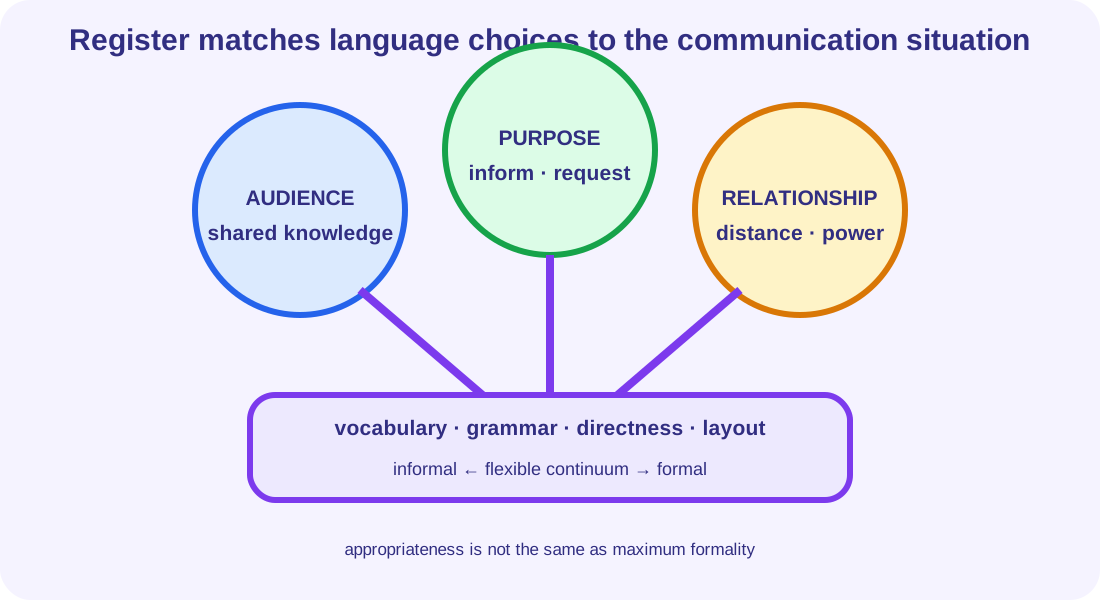
Register is a cluster of choices shaped by audience, purpose, channel, topic and relationship. A message to a close friend, a laboratory report and a request to an unfamiliar official can express the same basic content differently without one version being universally “better.”
Compare three requests
- Send me the file when you can. — direct and suitable in some familiar relationships.
- Could you send me the file by Friday, please? — neutral, clear and polite.
- I would be grateful if you could provide the file by Friday. — more ceremonious; useful only when the context warrants it.
What changes?
Register may affect terms, contractions, sentence complexity, hedging, greeting, sign-off and how directly a request is made. Technical vocabulary can be precise for specialists but obstructive for a general audience. Formal writing still benefits from clear verbs and concise sentences.
⚠️ Avoid mechanical rules
Contractions occur in many professional emails, while a legal clause may avoid ambiguity through highly controlled language. Passive voice can appropriately foreground a process, but it can also hide responsibility. Ask what the choice does in this text, not whether it belongs to a forbidden list.
📚 Căn cứ biên soạn
- Chương trình GDPT 2018.
- Mạch kiến thức Kết nối tri thức với cuộc sống lớp 12 và Quyết định 3588/QĐ-BGDĐT.
- Nội dung biên soạn độc lập, nhấn mạnh quy trình, bằng chứng và giới hạn của kết luận.
📚 Lý thuyết trọng tâm
Mục tiêu: Choose vocabulary, grammar, directness and layout for formal, neutral or informal contexts while avoiding the idea that formal language is always better or that contractions are always wrong.. Khi học Register in English: match language to audience, purpose and relationship, hãy xác định khái niệm, điều kiện áp dụng và mối liên hệ giữa các dữ kiện; không chỉ ghi nhớ kết luận.
🧭 Ví dụ có hướng dẫn
Chọn một tình huống điển hình của bài. Bước 1: ghi dữ kiện và câu hỏi cần giải quyết. Bước 2: chọn khái niệm hoặc quy tắc phù hợp. Bước 3: giải thích từng bước và kiểm tra kết quả với điều kiện ban đầu. Nếu đổi một dữ kiện, hãy dự đoán kết quả thay đổi thế nào.
✍️ Luyện tập
- Tóm tắt bài bằng ba ý: khái niệm, điều kiện và kết luận.
- Tự tạo một ví dụ đúng và một phản ví dụ; chỉ ra điểm quyết định.
- Giải lại ví dụ khi thay đổi một dữ kiện, sau đó nêu cách kiểm chứng.
Checklist tự đánh giá
- Tôi giải thích được “vì sao”, không chỉ nêu đáp án.
- Tôi nhận ra trường hợp không áp dụng được quy tắc.
- Tôi kiểm tra được đơn vị, bằng chứng hoặc tính hợp lí của kết luận.
Cùng nhau hiểu bài sâu hơn
Viết lời giải, công thức, đặt câu hỏi hoặc gửi ảnh phần bạn đang vướng.
Đăng nhập để đặt câu hỏi và tham gia trao đổi.
Chưa có trao đổi nào. Hãy là người đầu tiên đặt câu hỏi nhé.