🧠 Why do we “make a decision” but “do homework”?
Collocations are word partnerships preferred by a language community. Their choice is partly motivated but not fully predictable from translation, so store the verb together with its noun and an example.
Useful tendencies
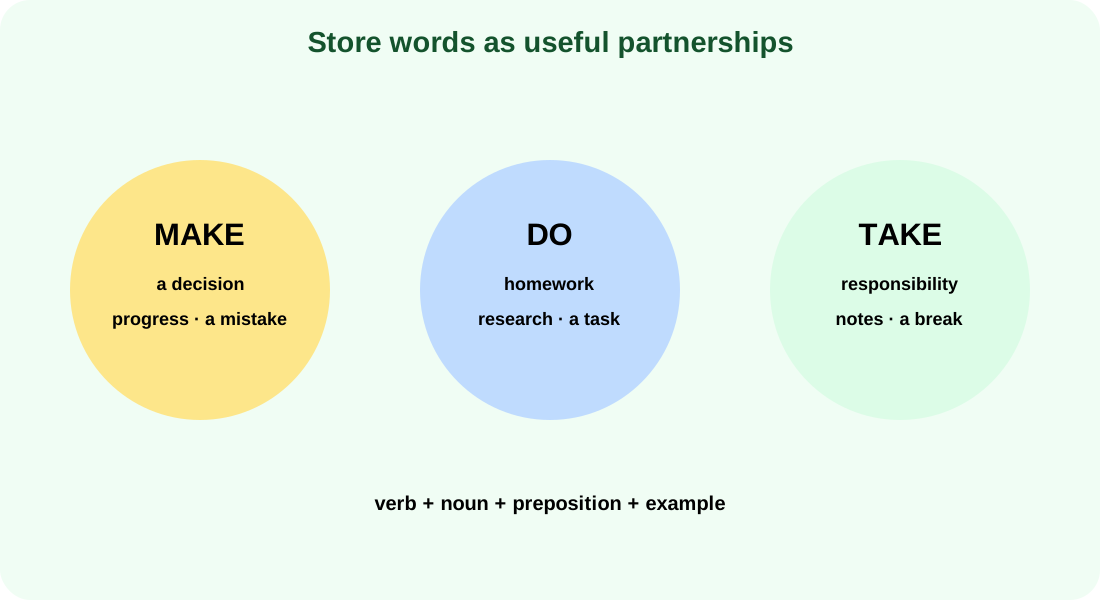
- make: create or produce a result—make a plan, mistake, promise, progress.
- do: perform work or an activity—do homework, research, exercise, a task.
- take: receive, use or experience—take notes, responsibility, a break, a risk.
Store grammar with the phrase
Learn make progress, not “make progresses”; do research into a topic; take responsibility for an error. The surrounding preposition and countability are part of usable knowledge.
⚠️ A rule is a memory aid, not a generator
English says make the bed although it is an activity, and take a photo although a photo is produced. Check a reliable dictionary or corpus when unsure.
✅ Build a three-part card
Write the whole collocation, one natural sentence and a contrast with a common error. Review by recalling the noun from the verb and the verb from the noun.
📚 Lý thuyết trọng tâm
Mục tiêu: Group common make, do and take combinations by meaning while checking authentic context instead of translating one verb.. Khi học Make, do, take: learn the whole collocation, hãy xác định khái niệm, điều kiện áp dụng và mối liên hệ giữa các dữ kiện; không chỉ ghi nhớ kết luận.
🧭 Ví dụ có hướng dẫn
Chọn một tình huống điển hình của bài. Bước 1: ghi dữ kiện và câu hỏi cần giải quyết. Bước 2: chọn khái niệm hoặc quy tắc phù hợp. Bước 3: giải thích từng bước và kiểm tra kết quả với điều kiện ban đầu. Nếu đổi một dữ kiện, hãy dự đoán kết quả thay đổi thế nào.
✍️ Luyện tập
- Tóm tắt bài bằng ba ý: khái niệm, điều kiện và kết luận.
- Tự tạo một ví dụ đúng và một phản ví dụ; chỉ ra điểm quyết định.
- Giải lại ví dụ khi thay đổi một dữ kiện, sau đó nêu cách kiểm chứng.
Checklist tự đánh giá
- Tôi giải thích được “vì sao”, không chỉ nêu đáp án.
- Tôi nhận ra trường hợp không áp dụng được quy tắc.
- Tôi kiểm tra được đơn vị, bằng chứng hoặc tính hợp lí của kết luận.
Cùng nhau hiểu bài sâu hơn
Viết lời giải, công thức, đặt câu hỏi hoặc gửi ảnh phần bạn đang vướng.
Đăng nhập để đặt câu hỏi và tham gia trao đổi.
Chưa có trao đổi nào. Hãy là người đầu tiên đặt câu hỏi nhé.