🔗 How do two sentences become one without repeating the noun?
A defining relative clause identifies exactly which person or thing we mean. The relative word replaces a repeated noun and also performs a job inside the clause.
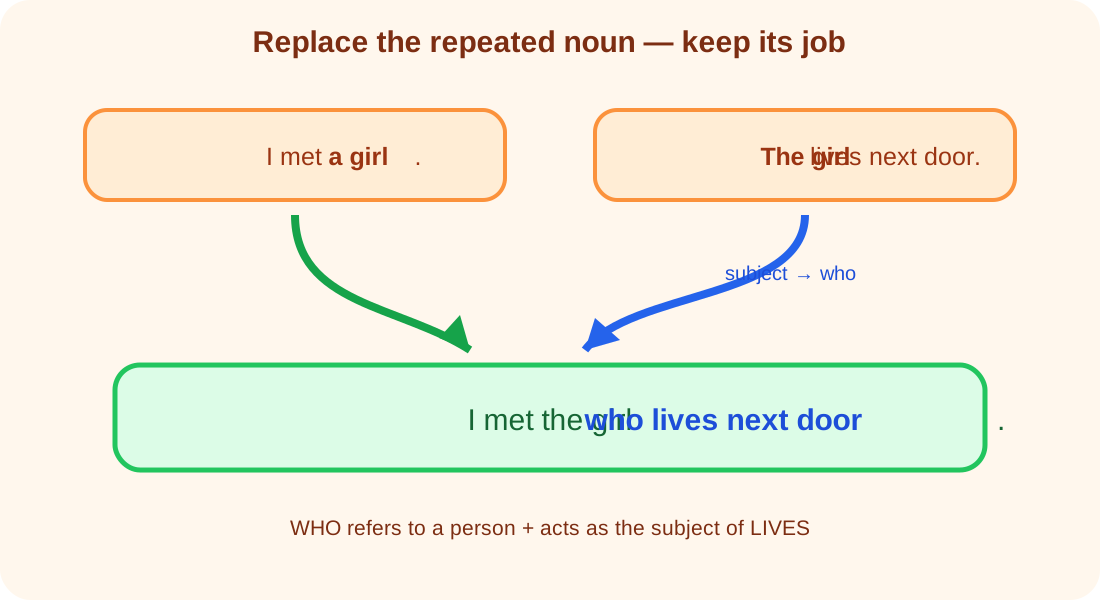
Choose by reference and grammatical job
- who/that refers to a person; which/that refers to a thing.
- whose expresses possession; where links a place to an event located there.
- A relative pronoun can be omitted only when it is the object in a defining clause: “The book (that) I borrowed”. A subject cannot be omitted: “The girl who lives…”
Find the missing role
“I borrowed the book. The book was useful.” In “I borrowed ___”, the repeated noun is the object, so “The book (that/which) I borrowed was useful” allows omission. In “The girl ___ lives next door”, the blank is the subject of lives, so who cannot disappear.
⚠️ Do not leave a duplicate pronoun
Write “The book that I borrowed”, not “The book that I borrowed it”. The relative pronoun already occupies the missing position. Also avoid where merely because a place word appears; check whether the clause needs a place expression or a subject/object.
✅ A three-question check
What noun am I identifying? Is it a person, thing, place or owner? What job is missing inside the relative clause? These questions are safer than memorising one-word pairs.
📚 Lý thuyết trọng tâm
Mục tiêu: Use who, which, that, whose, where and know when the pronoun can be omitted.. Khi học Relative clauses: identify exactly which person or thing you mean, hãy xác định khái niệm, điều kiện áp dụng và mối liên hệ giữa các dữ kiện; không chỉ ghi nhớ kết luận.
🧭 Ví dụ có hướng dẫn
Chọn một tình huống điển hình của bài. Bước 1: ghi dữ kiện và câu hỏi cần giải quyết. Bước 2: chọn khái niệm hoặc quy tắc phù hợp. Bước 3: giải thích từng bước và kiểm tra kết quả với điều kiện ban đầu. Nếu đổi một dữ kiện, hãy dự đoán kết quả thay đổi thế nào.
✍️ Luyện tập
- Tóm tắt bài bằng ba ý: khái niệm, điều kiện và kết luận.
- Tự tạo một ví dụ đúng và một phản ví dụ; chỉ ra điểm quyết định.
- Giải lại ví dụ khi thay đổi một dữ kiện, sau đó nêu cách kiểm chứng.
Checklist tự đánh giá
- Tôi giải thích được “vì sao”, không chỉ nêu đáp án.
- Tôi nhận ra trường hợp không áp dụng được quy tắc.
- Tôi kiểm tra được đơn vị, bằng chứng hoặc tính hợp lí của kết luận.
Cùng nhau hiểu bài sâu hơn
Viết lời giải, công thức, đặt câu hỏi hoặc gửi ảnh phần bạn đang vướng.
Đăng nhập để đặt câu hỏi và tham gia trao đổi.
Chưa có trao đổi nào. Hãy là người đầu tiên đặt câu hỏi nhé.